We install AC systems across Greater Los Angeles and Ventura County, including central air, ductless mini split, and heat pump installation. Every installation includes a Manual J load calculation, mechanical permit, and California Title 24 compliance inspection. Same-day consultations available, free written estimates, and no dispatch fee on approved work.
We install AC systems throughout Greater Los Angeles and Ventura County, including AC installation, central air installation, ductless mini split installation, and heat pump installation. The service area spans more than 30 communities where summer temperatures range from the low 80s near the Ventura Coast to 105°F and above in the inland San Fernando Valley and Santa Clarita Valley. Same-day consultations available, free written estimates, and no dispatch fee on approved work.
Central air installation is the standard choice for homes with existing ductwork in serviceable condition. The work starts with a Manual J load calculation, then a duct condition and sealing assessment, equipment selection at the appropriate SEER2 rating, the mechanical permit, installation, and the Title 24 inspection before commissioning. Central AC installation runs $3,500 to $8,000 depending on system size and efficiency rating. High-efficiency systems at 16 SEER2 and above reduce electricity bills over the system's 15 to 20 year lifespan.
Ductless mini split AC installation is the right solution for homes without central ductwork, which is a large share of the pre-1975 housing stock throughout the San Fernando Valley, and for room additions, ADUs, and garage conversions. A ductless mini split installs through a 3-inch wall penetration. Single-zone systems run $2,500 to $4,500 installed. Multi-zone systems run $5,500 to $13,000. Every ductless system is also a heat pump, delivering both cooling and heating from the same unit.
Heat pump installation replaces both the air conditioner and the furnace in a single system. Federal IRA tax credits of up to $2,000 apply to qualifying heat pump installations. For inland communities where winter nights drop hard, a hybrid system pairing a heat pump with gas furnace backup is the most practical configuration, and it works alongside an existing heating system rather than replacing it outright.
Every installation starts with the calculation, not the equipment. The contractor measures the home, reviews insulation and window area, and confirms duct condition before recommending any system. Licensing is verified before your appointment, and pricing is confirmed in writing before work begins.
Existing ductwork: homes with ductwork in good condition are strong candidates for central air installation. Homes without ductwork, or with ductwork too deteriorated to justify repair, are better served by ductless mini split installation.
Heating situation: homeowners replacing an aging furnace and air conditioner at the same time should seriously evaluate heat pump installation, which is one system for both, may qualify for IRA tax credits, and leaves one less piece of equipment to maintain.
Budget and efficiency priorities: high-efficiency systems at 16 SEER2 and above cost more upfront and deliver lower operating costs. Standard efficiency systems have a lower installation cost and higher monthly bills. The contractor calculates the payback period before recommending.
Manual J load calculation: determines the correct system capacity before any equipment is selected. This is not optional. No reliable installation happens without it.
Duct assessment: existing ductwork is inspected for leakage, insulation, and sizing. A leaky duct system loses 20 to 30 percent of conditioned air before it reaches the living space.
Equipment selection: Carrier, Trane, Lennox, and Rheem systems are commonly specified. The right brand matters less than the right capacity and efficiency tier for the application.
Mechanical permit: required for all AC installations in California, and pulled before any installation work begins.
Installation and commissioning: equipment installed, refrigerant charged to specification, airflow balanced at registers, and thermostat programmed before the contractor leaves.
Title 24 inspection: California energy code compliance inspection completed and documented.
Central air installation is the right choice when quality ductwork already exists and the home benefits from uniform cooling through a single distribution system. One outdoor unit, one air handler, and one thermostat. If the current system is failing rather than aging out, AC repair is usually the cheaper first step.
Ductless mini split installation is the right choice when ductwork is absent, when specific rooms need independent temperature control, or when a room addition cannot practically be connected to the existing central system. Ductless systems are also heat pumps, so the same unit that cools in summer heats in winter. For homeowners replacing baseboard heaters or wall heaters in homes without central ductwork, ductless is almost always the most cost-effective solution.
All new AC installations must meet a minimum of 15 SEER2 under current California energy code. Systems at 16 to 18 SEER2 deliver meaningfully lower operating costs, particularly in Greater LA's climate where AC runs 5 to 6 months per year. A 17 SEER2 system typically pays back the efficiency premium in 4 to 6 years and keeps delivering savings for the remaining 10 to 14 years of system life. The contractor calculates the payback period before recommending an efficiency tier.
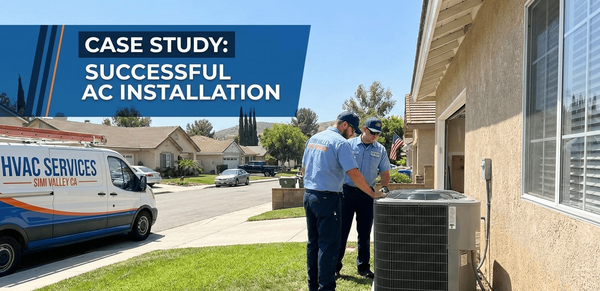
The Martinez Family, Simi Valley, CA 93065
In late June, the Martinez family's 18-year-old AC unit gave out overnight, right in the middle of peak Simi Valley summer with indoor temperatures hitting 88°F and two young kids at home. They needed a replacement fast, but were burned by inconsistent quotes from other local HVAC companies, anxious about failing a California Title 24 inspection, and could not afford to wait on a week-long back-order.
Within 3 hours of their call, a licensed technician was on-site in Wood Ranch, with the $0 dispatch fee applied on approval. After a full Manual J load calculation and ductwork assessment, we presented a written, itemized estimate with three equipment options, right there at the kitchen table. The Martinez family chose a Carrier 16 SEER2 system, qualifying for a Southern California Edison rebate. Our crew completed the full installation, including duct sealing and a thermostat upgrade, and passed the Ventura County Title 24 HERS inspection the same afternoon.
The entire project, including assessment, installation, and the Ventura County Title 24 HERS inspection, was completed in a single day. The Martinez family immediately saw a 31% drop in monthly cooling costs, captured a $225 Southern California Edison rebate, and paid exactly what the written estimate quoted. Not a dollar more. The $0 dispatch fee was waived on approval, and their new system is covered by a 10-year manufacturer warranty plus a 2-year labor guarantee.
“"I was spending a fortune on window units that never actually cooled the back bedroom. The HVAC Services Team crew installed the whole mini-split system in two days, didn't damage a single wall, and my electricity bill dropped by almost half. Wish I'd done it years ago." David Chen, Northridge CA”