Best Energy-Efficient AC Systems Southern California 2026

Best Energy-Efficient AC Systems for Southern California Climate
When summer temperatures start rising in Simi Valley and Ventura, a reliable air conditioning system becomes a necessity. But with rising energy costs and hotter seasons, it's also essential to choose an air conditioner that keeps you cool without draining your wallet. That's where the best energy-efficient AC systems for Southern California come into play.
In this comprehensive guide, we'll walk you through:
- Why efficiency matters in Southern California's climate
- What SEER rating really means for your home
- Our top recommended high-SEER AC units for Simi Valley homeowners
- How you can save with Energy Star AC California rebate programs and tax incentives
- Important tips for maximizing performance and lowering ongoing costs
Why Energy Efficiency Matters in Simi Valley & Ventura
Southern California's climate — especially in inland communities like Simi Valley, Chatsworth, Woodland Hills, and Thousand Oaks — is characterized by long, hot summers with temperatures frequently reaching the high 80s to 100°F+. This means your air conditioning system may run daily for four to six months each year. While necessary for comfort and health, that runtime translates directly into your electricity bill — and an inefficient system multiplies that cost every single day it operates.
According to the U.S. Department of Energy, air conditioning accounts for approximately 12% of total home energy expenditure nationally — and significantly more in hot-climate regions like the San Fernando Valley and Ventura County, where cooling demand far exceeds the national average.
Here's why energy efficiency matters for Southern California homeowners specifically:
- Lower electricity bills: Efficient units consume measurably less power over the same runtime — the difference between a 14 SEER and a 20 SEER unit running 8 hours daily in a Simi Valley summer is hundreds of dollars annually
- Extended system life: Optimized systems with variable-speed compressors run at lower capacity more consistently, reducing mechanical wear versus single-stage units that cycle on and off at full power
- Environmental benefits: California's SCAQMD air quality mandates make energy reduction an environmental priority — less electricity consumption means reduced demand on Southern California's grid during peak summer hours
- Rebates and tax incentives: High-efficiency systems qualify for significant financial incentives that reduce net installation cost — detailed below
What Is SEER and Why It Matters
SEER stands for Seasonal Energy Efficiency Ratio — the standard measurement for how efficiently an air conditioner cools a home relative to the electricity it consumes over a full cooling season. The Air Conditioning, Heating, and Refrigeration Institute (AHRI) maintains the testing standards that determine SEER ratings for all certified equipment.
The higher the SEER number:
- The more efficient the system
- The lower your cooling costs per hour of runtime
- The better the performance consistency during sustained heat events common in Simi Valley and the San Fernando Valley
For context — older AC systems installed in Simi Valley homes in the 1990s and early 2000s typically carry SEER ratings of 10–13. Modern high-efficiency systems achieve SEER 20–26+, meaning they deliver the same cooling for 50–60% less electricity. If your home has an aging AC system or you've been scheduling increasingly frequent AC repairs, the efficiency gap between your current system and a modern replacement is likely costing you significantly each summer.
SEER Guidelines for California
California follows SEER2 — an updated rating standard implemented in 2023 that uses a more rigorous testing protocol closer to real-world operating conditions. Under California's Title 24 Building Energy Efficiency Standards, minimum efficiency requirements for new AC installations are among the strictest in the nation.
General SEER benchmarks for Southern California homeowners:
- SEER 16+ — qualifies for most rebate programs and incentives
- SEER 18–26+ — considered high efficiency; significant annual savings versus baseline
- SEER 20+ — optimal for hot inland climates like Simi Valley, Chatsworth, Canoga Park, and Granada Hills where cooling seasons are longest
Top Energy-Efficient AC Systems for Southern California in 2026
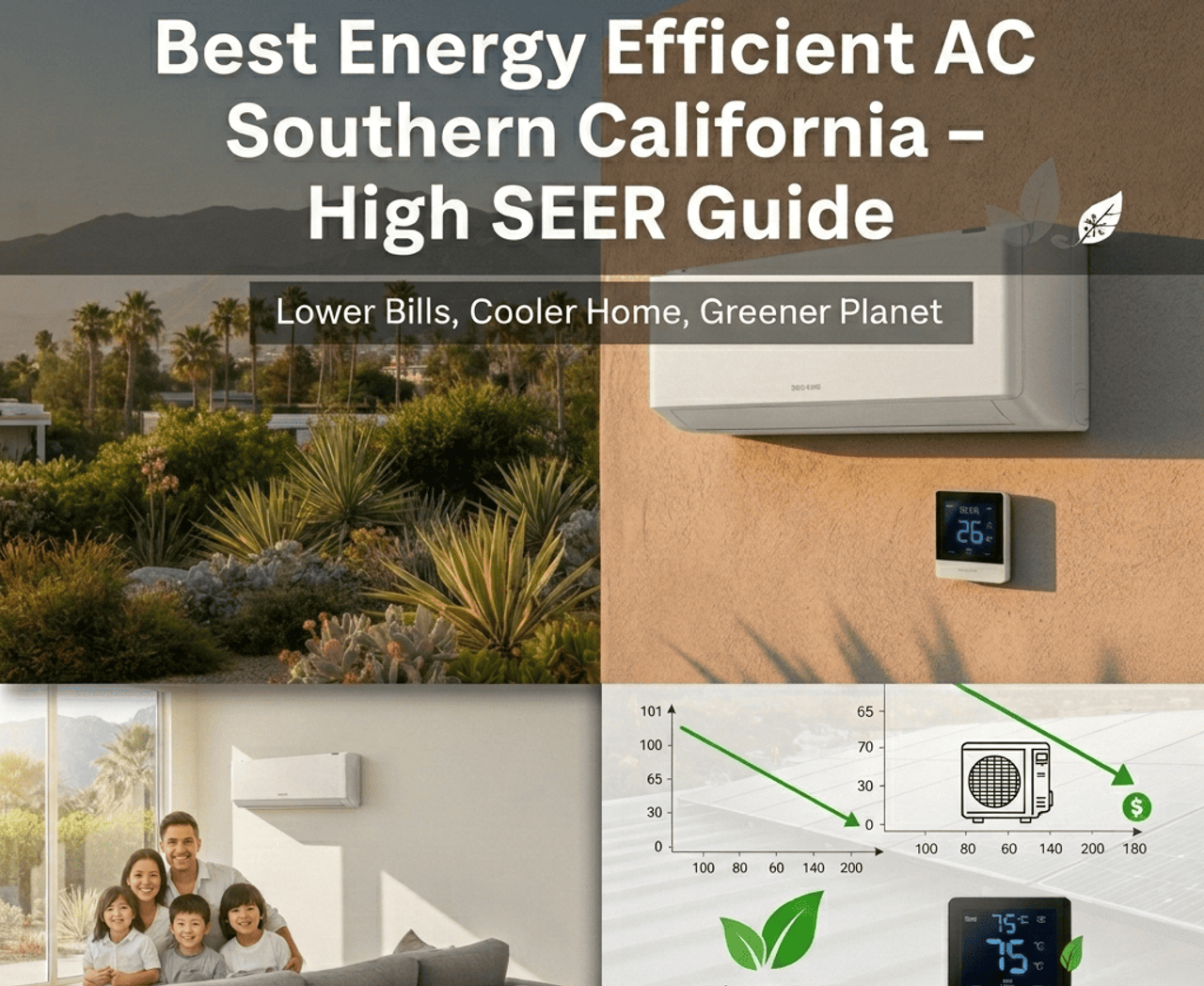
Below are the most efficient and reliable AC systems for Southern California homes — from central units to ductless systems — based on SEER performance, reliability data, and suitability for Ventura County's specific climate conditions.
1. Lennox XC25 — Premium High-Efficiency Central AC
SEER: Up to 26 Type: Central air conditioner
Why it performs in Southern California: The XC25's variable-speed compressor modulates output in increments as small as 0.5% — meaning it runs almost continuously at low capacity rather than cycling on and off at full power. In Simi Valley's sustained summer heat where your AC runs for hours at a stretch, this translates to superior temperature consistency and substantially lower peak electricity draw versus single-stage units.
Best for: Whole-home cooling in homes with existing ductwork. If your ducts are aging or compromised, have them assessed before installation — duct losses can eliminate efficiency gains from even a SEER 26 unit. Our partners offer duct inspection as part of full AC installation assessments throughout Ventura County.
- Pros: Outstanding efficiency, quieter operation, precise humidity control, qualifies for maximum available rebates
- Cons: Higher upfront cost — though available rebates and annual energy savings typically deliver payback within 5–8 years at Southern California electricity rates
2. Mitsubishi Ductless Mini-Split Systems
SEER: Up to 30+ (select models) Type: Ductless mini-split
Why it performs in Southern California: Mitsubishi's hyper-inverter technology makes their mini-split systems among the most efficient cooling products available anywhere. Critically, they eliminate the duct losses that the EPA's Energy Star program estimates account for 30%+ of energy consumption in central forced-air systems — a significant factor in older Simi Valley, Northridge, and Chatsworth homes where ductwork was installed decades ago and has never been sealed or upgraded.
Mitsubishi's multi-zone systems also allow precise room-by-room temperature control — meaning you're not cooling unoccupied rooms, which is where most residential cooling waste occurs.
Best for: Homes without existing ductwork, room additions, converted garages, ADUs, and targeted cooling in specific rooms. Particularly well-suited to Simi Valley, Moorpark, and Camarillo homes built in the 1970s where duct extension isn't practical. If you're evaluating whether a ductless mini-split is the right fit for your home, our partners provide free in-home assessments with itemized quotes.
- Pros: Highest available SEER ratings, zone-by-zone control, no duct losses, excellent humidity management, qualifies for Inflation Reduction Act heat pump credits
- Cons: Higher per-zone cost; multi-room installations with multiple indoor heads increase total project cost
3. Carrier Infinity Series (Infinity 26)
SEER: Up to 24 Type: Central AC
Why it performs in Southern California: The Carrier Infinity 26 pairs a variable-speed Greenspeed compressor with Carrier's Infinity Touch control system, which uses outdoor temperature data to proactively adjust cooling output before indoor temperatures drift. In Woodland Hills, West Hills, and Porter Ranch — where summer temperatures can swing 20°F+ between morning and afternoon — this predictive operation prevents the comfort lag common with single-stage units.
Best for: Families prioritizing both efficiency and smart-home integration. Compatible with Google Home, Amazon Alexa, and Apple HomeKit for remote monitoring and scheduling.
- Pros: Excellent balance of performance and efficiency, smart thermostat integration, quiet operation, strong warranty support
- Cons: Mid-to-high pricing tier; smart features require reliable home WiFi for full functionality
4. Trane XV20i
SEER: Up to 21.5 Type: Central AC
Why it performs in Southern California: Trane's TruComfort variable-speed technology adjusts in 1% increments — delivering consistent temperatures that single-stage systems simply cannot match during Simi Valley's sustained 100°F+ heat days. The XV20i also integrates with Trane's ComfortLink II smart thermostat for usage monitoring and remote diagnostics that can identify efficiency degradation before it becomes a repair call.
Best for: Larger homes in consistently hot inland communities — Simi Valley, Santa Clarita, Valencia, and Canyon Country — where whole-house comfort consistency matters most.
- Pros: Excellent whole-home performance, proven reliability, strong dealer network throughout Ventura County and the San Fernando Valley
- Cons: Slightly higher cost than standard efficiency models; SEER cap of 21.5 is lower than premium competitors
Energy Star AC California Rebate & Tax Incentives
One of the most financially compelling reasons to upgrade your AC system in 2026 is the combination of federal tax credits, state programs, and local utility rebates that can significantly reduce net installation cost. Here's a complete breakdown of what's available to Southern California homeowners.
Federal Energy Efficient Home Improvement Tax Credit
Under the Inflation Reduction Act's 25C tax credit, homeowners installing qualifying high-efficiency HVAC equipment can claim:
- 30% federal tax credit on the cost of qualifying equipment and installation
- Up to $600 for central AC systems (SEER2 ≥ 16 required)
- Up to $2,000 for qualifying heat pump systems — if you're considering a heat pump instead of a traditional AC, the credit ceiling is significantly higher
- Credits are non-refundable but can be carried forward
Consult a tax professional or visit IRS Publication 5967 for current eligibility rules. Our HVAC partners provide the documentation required for credit claims as part of every qualifying installation.
California and Local Utility Rebates
Southern California Edison (SCE) Rebates Southern California Edison's residential rebate program offers rebates for qualifying ENERGY STAR certified AC systems. Rebate amounts vary by SEER level and equipment type — check current offerings directly with SCE or ask your HVAC partner to pull current rebate availability for your service area at time of installation. Our partners serving Simi Valley, Thousand Oaks, Moorpark, and Camarillo assist with SCE rebate documentation on every installation.
Clean Power Alliance Rebates The Clean Power Alliance — which serves much of Ventura County — offers instant rebate programs on ENERGY STAR certified equipment. Eligibility and amounts change seasonally; confirm current availability when scheduling your installation assessment.
SoCalGas Rebates For homes upgrading from gas-powered systems or installing gas-connected heat pumps, SoCalGas rebate programs provide additional incentives for qualifying high-efficiency equipment. Relevant for homeowners in Simi Valley and Ventura County considering dual-fuel heat pump systems.
All utility rebates typically require:
- ENERGY STAR certified equipment
- Professional installation by a licensed contractor
- Matched condenser and coil (mismatched systems are ineligible)
TECH Clean California
TECH Clean California is a statewide initiative offering rebates of $1,000–$4,500+ for heat pump HVAC upgrades — specifically designed to accelerate California's transition away from gas heating systems. If your upgrade involves replacing a gas furnace with a heat pump system or adding a ductless heat pump mini-split, TECH Clean California rebates can dramatically reduce net installation cost.
Always ask your HVAC partner about current TECH Clean California availability — rebate pools are allocated annually and availability varies by region. Our partners serving Ventura County and the San Fernando Valley track current rebate availability and handle application paperwork on qualifying installations.
Installation & Long-Term Savings Tips
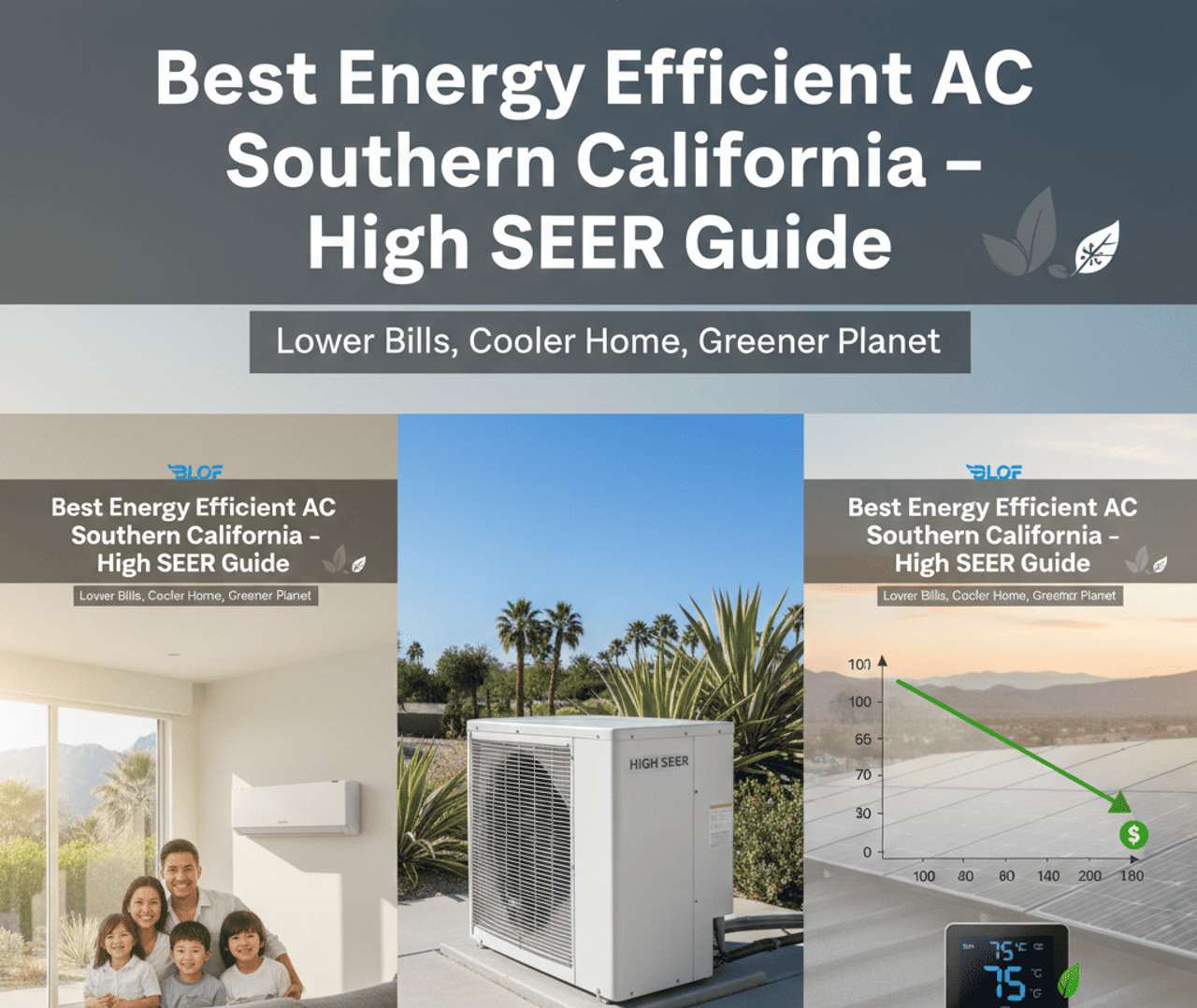
Upgrading to a high-SEER system is only half the equation. Installation quality and ongoing practices determine whether you actually achieve the efficiency ratings the equipment is capable of delivering.
Choose Proper Sizing An oversized AC unit short-cycles — running at full capacity for brief bursts rather than sustained low-capacity operation — producing humidity control problems and efficiency losses that negate the SEER rating entirely. An undersized unit runs constantly without achieving setpoint on the hottest days. Manual J load calculation is the industry standard for proper sizing — our partners perform this assessment before every installation. Never accept a sizing recommendation based solely on square footage without a full load calculation.
Assess Your Ductwork First The EPA estimates that duct leakage accounts for 20–30% of energy losses in homes with central air systems — meaning a SEER 20 system operating through leaky ducts performs closer to SEER 14 in real-world conditions. If your home has aging ductwork, have it professionally inspected before investing in a high-efficiency system. Our AC installation partners include duct assessment as part of full system replacement consultations.
Install a Smart Thermostat Energy Star certified smart thermostats save an average of 8% on cooling costs annually through automatic scheduling and occupancy-based adjustment. All four manufacturer systems listed above integrate with leading smart thermostat platforms. Pair with a whole-home indoor air quality system for comprehensive comfort monitoring.
Schedule Annual Pre-Season Maintenance A properly maintained AC system maintains its efficiency rating; a neglected system degrades. Annual pre-season maintenance covering coil cleaning, refrigerant level verification, capacitor testing, and electrical connection inspection should be completed before Southern California's cooling season begins. Our AC maintenance partners serving Simi Valley and Ventura County offer pre-season tune-ups with free cost estimation and $0 dispatch fee with approved service.
Address Hard Water Impact on HVAC Components Ventura County's water supply — registering 15–25 grains per gallon hardness in most service areas — accelerates scale buildup in condensate drain pans and coil fins over time. Pairing your AC upgrade with a whole-home water softener installation or water filtration system reduces mineral deposit accumulation in HVAC components, extending service life between maintenance intervals.
Seal and Insulate Your Home The California Energy Commission's Title 24 compliance standards exist precisely because insulation and air sealing directly determine how hard your AC system has to work. Effective attic insulation, sealed penetrations, and weatherstripped doors and windows reduce cooling load — meaning your high-efficiency system runs at even lower capacity, compounding the efficiency gains of the unit itself.
Final Thoughts — Best Energy-Efficient AC Systems for Southern California
Choosing the right high-efficiency AC system for your Simi Valley, Ventura County, or San Fernando Valley home is an investment that pays returns in comfort, energy savings, and property value — particularly as California's electricity rates continue their long-term upward trend.
High-SEER systems like the Lennox XC25, Mitsubishi ductless mini-splits, Carrier Infinity 26, and Trane XV20i represent the current best-in-class options for Southern California's climate conditions. Combined with available federal tax credits, SCE rebates, and TECH Clean California incentives, the net cost of a high-efficiency upgrade in 2026 is significantly lower than the sticker price suggests.
Your action checklist:
- Target SEER 16+ minimum — SEER 20+ for inland Ventura County and San Fernando Valley communities
- Confirm ENERGY STAR certification for rebate eligibility
- Request a free in-home assessment and cost estimation — our partners cover Simi Valley, Moorpark, Thousand Oaks, Chatsworth, Northridge, Woodland Hills, West Hills, Camarillo, and all of Ventura County
- Ask specifically about TECH Clean California and SCE rebate availability for your address
- Consider pairing your AC upgrade with a ductless mini-split assessment if any rooms in your home are poorly served by your current central system
- Evaluate indoor air quality improvements during the same installation visit — new systems are the optimal time to add filtration and ventilation upgrades
- Confirm $0 dispatch fee with approved service and free cost estimation before committing to any partner
With the right system, the right incentives, and a properly executed installation — efficient, affordable cooling throughout Southern California's summers is absolutely achievable.
Frequently Asked Questions — Energy-Efficient AC Systems in Southern California
What is the best AC system for Simi Valley's climate in 2026?
For Simi Valley's hot, dry summers — where temperatures regularly reach 95–105°F from June through September — the best AC systems are variable-speed units rated SEER 18 or higher. The Mitsubishi ductless mini-split leads for homes without existing ductwork, while the Lennox XC25 and Carrier Infinity 26 are the top central AC options for homes with existing duct systems. Variable-speed operation is non-negotiable for Simi Valley's sustained heat — single-stage units that cycle on and off at full power consume significantly more electricity and fail to maintain consistent indoor temperatures during multi-day heat events. If you're unsure which system fits your home, our partners offer free in-home assessments throughout Simi Valley and Ventura County with no obligation to purchase.
How much does a high-efficiency AC installation cost in Simi Valley?
In Simi Valley and the broader Ventura County area, expect to pay $4,500–$9,500 installed for a high-efficiency central AC system (SEER 16–26), depending on unit size, brand, and whether ductwork modifications are required. Ductless mini-split installations typically range $2,500–$5,500 per zone. After applying available rebates — including the federal 25C tax credit (up to $600 for AC, up to $2,000 for heat pumps), Southern California Edison rebates, and TECH Clean California incentives — net cost can be reduced by $1,500–$4,000+ depending on the system and your specific eligibility. Always get free cost estimation with itemized quotes before approving any installation — our network partners provide this at $0 dispatch fee with approved work.
What SEER rating do I need for a Southern California home?
The absolute minimum for a new AC installation in California under current Title 24 standards is SEER2 15 for split systems. However, for Southern California's climate specifically, HVAC professionals recommend:
- SEER 16–18 — adequate for coastal communities like Ventura, Camarillo, and Malibu with moderate summer temperatures
- SEER 18–22 — recommended for inland valley communities like Simi Valley, Moorpark, Thousand Oaks, and Newbury Park
- SEER 22+ — optimal for the hottest inland locations: Chatsworth, Woodland Hills, Canoga Park, Granada Hills, and Van Nuys where summer temperatures consistently exceed 100°F
The U.S. Department of Energy's SEER guidance confirms that higher SEER ratings deliver proportionally greater savings in high-cooling-demand climates — making the premium investment more justifiable in Simi Valley than in cooler California regions.
Can I get a rebate on a new AC installation in Simi Valley?
Yes — and in 2026, the combination of available incentives makes this one of the best times financially to upgrade. Simi Valley homeowners can access:
- Federal 25C Tax Credit — 30% of equipment and installation cost, up to $600 for central AC (SEER2 ≥ 16) or up to $2,000 for qualifying heat pump systems
- Southern California Edison rebates — available for ENERGY STAR certified systems in SCE service territory covering most of Simi Valley and Ventura County
- TECH Clean California — $1,000–$4,500+ for heat pump upgrades replacing gas heating systems
- Clean Power Alliance — instant rebates on qualifying room and central AC units for CPA service area customers
Rebate availability changes seasonally and is subject to funding pool limits. Our installation partners check current rebate eligibility for your specific address at time of assessment and handle all documentation. Contact us for a free estimate that includes a current rebate summary for your home.
Is a ductless mini-split better than central AC for a Simi Valley home?
It depends on your home's layout and existing infrastructure — but for many Simi Valley homes, especially those built in the 1960s–1980s with aging ductwork, a ductless mini-split is the more efficient choice. Here's why:
The EPA estimates that duct losses account for 20–30%+ of energy consumption in central air systems. In older Simi Valley homes where ducts haven't been sealed or replaced, a SEER 30 mini-split will outperform a SEER 20 central system in real-world energy consumption because it eliminates distribution losses entirely.
Choose central AC if: Your home has well-maintained ductwork, you want whole-home conditioning from a single system, and you prefer a single outdoor unit.
Choose ductless mini-split if: Your home lacks ductwork or has aging ducts, you want zone-by-zone temperature control, you're conditioning a room addition or ADU, or you want maximum efficiency. Our partners serving Simi Valley, Chatsworth, Northridge, and West Hills assess both options with side-by-side cost and efficiency comparisons before any recommendation. Explore ductless mini-split installation options here.
How long does a high-efficiency AC last in Southern California?
A properly installed and maintained high-efficiency AC system in Southern California typically lasts 15–20 years, though the extended cooling season — often 5–6 months of sustained daily operation — means annual maintenance is more critical here than in cooler climate regions. According to ASHRAE's equipment life expectancy guidelines, the average service life for a residential central AC system is 15–20 years under normal operating conditions.
Factors that extend AC lifespan in Simi Valley specifically:
- Annual pre-season maintenance covering coil cleaning, refrigerant verification, and electrical inspection — our AC maintenance partners serve all Ventura County communities
- Hard water treatment — Ventura County's 15–25 grain-per-gallon water hardness accelerates mineral deposits on coil fins and in condensate systems; a water softener reduces this accumulation
- Proper sizing — oversized units that short-cycle experience dramatically accelerated wear versus correctly sized variable-speed systems
- Prompt repair of minor issues — a failed capacitor diagnosed early costs $150–$300; the same failure left unaddressed can destroy a compressor worth $1,200–$2,800
What happens if my AC breaks down during a Simi Valley heat wave?
An AC failure during a Simi Valley heat wave — when temperatures hold above 95°F for days at a stretch — is a genuine health risk, particularly for elderly residents, young children, and anyone with cardiovascular or respiratory conditions. The CDC identifies extreme heat as the leading weather-related cause of death in the United States.
What to do immediately:
- Check your thermostat batteries and settings first — a surprising percentage of "AC failures" are thermostat issues
- Check the circuit breaker — a tripped breaker from an electrical fault is common during high-demand periods
- Check the outdoor condenser unit — if the fan isn't spinning, a failed capacitor (a same-day repair) may be the cause
- If none of these resolve it, call for same-day service immediately — don't wait overnight
HVAC Services Team connects Simi Valley and Ventura County homeowners with licensed AC repair specialists available same-day, with confirmed arrival windows — not open-ended scheduling ranges — and $0 dispatch fee with approved repairs. During heat emergencies, the majority of common AC failures — capacitor replacement, refrigerant recharge, thermostat fault, contactor failure — are resolved on the first visit.
Should I repair or replace my AC in Simi Valley?
The 50% rule is the most reliable decision framework: if the repair cost exceeds 50% of the replacement value of your current system, replacement delivers better long-term value. Additional indicators that favor replacement over repair:
- System is 12+ years old — approaching or past expected service life in Southern California's heavy-use climate
- Refrigerant is R-22 — phased out under EPA regulations; recharging R-22 systems is increasingly expensive and environmentally problematic
- Energy bills have increased year-over-year without a change in usage — efficiency degradation is compounding costs daily
- You've had two or more significant repairs in the past three years — a pattern that typically accelerates
- The system cannot maintain setpoint on the hottest Simi Valley days even when functioning — indicating chronic undersizing or severe efficiency loss
If you're on the fence, our AC repair and installation partners provide a transparent repair-versus-replace cost comparison during every diagnostic visit — including projected energy savings from a replacement system — before any recommendation is made. Free cost estimation, $0 dispatch fee with approved work.
How do I know if my AC is big enough for my Simi Valley home?
Sizing is one of the most common — and most consequential — mistakes in AC installation. Signs your current AC may be incorrectly sized:
Oversized indicators:
- AC cools quickly but cycles on and off frequently (short-cycling)
- High indoor humidity despite cooling — oversized units don't run long enough to dehumidify properly
- Uneven temperatures room-to-room
- Higher-than-expected energy bills despite adequate cooling
Undersized indicators:
- AC runs constantly but never reaches thermostat setpoint on hot days
- Some rooms consistently warmer than others
- System struggles specifically during Simi Valley's 100°F+ peak heat days
Proper sizing requires a Manual J load calculation — the ACCA industry standard that accounts for your home's square footage, insulation values, window area, orientation, and local climate data. Our installation partners perform Manual J calculations before every AC installation in Simi Valley, Thousand Oaks, Moorpark, Chatsworth, Woodland Hills, and across Ventura County — never recommending a unit based on square footage alone.
Does a new AC system improve indoor air quality?
A new high-efficiency AC system contributes to better indoor air quality in two ways: improved filtration capacity (modern systems accommodate higher-MERV filters without airflow restriction) and better dehumidification through more consistent low-capacity operation. However, an AC system alone is not a comprehensive air quality solution.
The EPA consistently ranks indoor air pollution among the top five environmental health risks, noting indoor air is often 2–5x more polluted than outdoor air. For complete indoor air quality improvement alongside your AC upgrade, our partners assess:
- Whole-home HEPA or media filtration — removes particulates, allergens, and dust
- UV-C germicidal light systems — neutralizes biological contaminants in the air handler
- Energy Recovery Ventilators (ERVs) — introduces fresh filtered outdoor air without losing conditioned air
- Whole-home humidifier/dehumidifier — maintains optimal humidity independently of cooling demand
Ask your installation partner to include an indoor air quality assessment during your AC installation visit — the optimal time to add these systems is during a full HVAC replacement when access to the air handler and ductwork is already established. Free cost estimation included.
How often should I service my AC in Southern California?
Once annually — before cooling season begins — is the minimum recommendation for Southern California homeowners. Given that Simi Valley's cooling season runs approximately May through October, scheduling your tune-up in March or April ensures your system is operating at peak efficiency before sustained heat demand begins.
Annual service covers:
- Evaporator and condenser coil cleaning — dirty coils reduce efficiency by up to 30% per DOE data
- Refrigerant level verification — low refrigerant forces the compressor to work harder, increasing energy consumption and accelerating wear
- Capacitor and contactor inspection — the most common causes of AC failure during heat waves
- Condensate drain clearing — clogged drains cause water damage and trigger safety shutoffs
- Electrical connection tightening — loose connections increase resistance and fire risk
- Filter replacement — clogged filters are the single most common cause of reduced airflow and efficiency loss
HVAC Services Team connects Simi Valley, Moorpark, Thousand Oaks, Chatsworth, Northridge, and all Ventura County homeowners with annual AC maintenance partners offering free cost estimation and $0 dispatch fee with approved service. Schedule your pre-season tune-up today.
What is the difference between a heat pump and an AC in Southern California?
This is one of the most common questions from Southern California homeowners considering an upgrade in 2026 — and the distinction matters significantly for both efficiency and available incentives.
Standard AC: Cools only. Requires a separate furnace or heating system for winter. Uses refrigerant to move heat from inside your home to outside.
Heat pump: Cools in summer and heats in winter using the same refrigerant-based mechanism — simply reversing the direction of heat transfer. In Southern California's mild winters, heat pumps are dramatically more efficient than gas furnaces for heating because they move heat rather than generate it, delivering 2–4 units of heat energy for every 1 unit of electrical energy consumed.
Why this matters in 2026: The Inflation Reduction Act offers up to $2,000 in federal tax credits for qualifying heat pump installations — more than triple the $600 AC credit — specifically to incentivize this transition. TECH Clean California adds another $1,000–$4,500+ for heat pump upgrades replacing gas heating.
For Simi Valley and Ventura County homeowners currently running separate gas furnace + AC systems, replacing both with a single high-efficiency heat pump or ductless heat pump mini-split in 2026 is one of the highest-ROI home improvement decisions available — combining heating and cooling efficiency gains with the largest available rebate stack. Our partners provide side-by-side heat pump versus traditional AC comparisons with specific cost and rebate calculations during every assessment visit.