Best Time to Install a New AC near me California 2026

When is the best time to install a new AC near me in California?
The best time to install a new AC in California is October through February. During this off-peak window, installation costs are 10–20% lower, contractors have more availability, and equipment is not in short supply. For homeowners in Simi Valley and Ventura County, March and April are the last viable budget-friendly months before summer demand peaks in June–August. All new AC systems installed in 2026 must use R-454B or R-32 refrigerant (replacing R-410A). Qualifying systems are eligible for up to $2,000 in federal IRA tax credits.
- The 2026 California AC Installation Timing Overview
- Month-by-Month Cost & Availability Breakdown
- Simi Valley Microclimate: Why Local Timing Matters
- Interactive AC Cost Estimator Tool
- 2026 Refrigerant Transition: R-454B Explained
- IRA Rebates & California Incentives 2026
- Repair vs. Replace: The $5,000 Rule
- SEER2 Comparison Table
- How to Size Your New AC for California Homes
- How to Find a Vetted AC Installer Near You
- Frequently Asked Questions
The 2026 California AC Installation Timing Overview
If you're searching for the best time to install a new AC near you in California, the answer depends on three overlapping factors: seasonal demand cycles, the 2026 refrigerant transition to R-454B, and the availability of IRA federal tax credits. Getting all three aligned can save you $1,500–$3,500 on a complete installation.
California's HVAC market operates on a predictable demand curve. Installations spike sharply from May through August, when summer heat drives emergency replacements. During peak season in Ventura County, wait times for licensed HVAC contractors can extend to 5–14 business days, and contractor quotes run 12–22% higher than the same job performed in November.
Every year, homeowners who waited too long pay $200–$400 more per installation and wait twice as long for service. The moment you notice symptoms — inconsistent cooling, rising energy bills, strange noises — is the moment to act, not to wait for summer.
The 2026 Seasonal Opportunity Matrix
Fall & Early Winter
- 10–20% lower installation cost
- Contractor availability: Excellent
- Equipment in full stock
- No emergency surcharges
- Time to claim IRA credit before year-end
Late Winter & Early Spring
- 5–12% savings vs. summer rates
- Good availability (Ventura County)
- Beat the spring pre-booking rush
- Simi Valley: last chance before May surge
Late Spring
- Demand rising sharply
- 8–15% premium over off-peak
- Booking 2–3 weeks out typical
- Limited equipment selection
Peak Summer
- 12–22% premium on installation
- 5–14 day wait times in Ventura County
- Emergency call-out fees common
- Only viable if AC fails completely
Month-by-Month Cost & Availability Breakdown
Homeowners searching "AC installation near me California" during March–May face the fastest-rising contractor availability window of the year. Data from Ventura County HVAC contractors shows quote acceptance rates drop from 94% in March to 61% by mid-May as schedule slots fill. If your AC is 10+ years old or running R-22/R-410A refrigerant, spring 2026 is your optimal replacement window — before summer emergency pricing adds $1,200–$3,000 to the same job.
Understanding the cost trajectory by month is the single most actionable insight for California homeowners planning to install a new AC near them. The table below reflects real 2026 Ventura County / Simi Valley market data.
| Month | Demand Level | Avg. Install Cost (3-ton Central) | Wait Time | vs. Oct Baseline | Recommendation |
|---|---|---|---|---|---|
| October | Very Low | $6,200–$8,400 | 1–3 days | Baseline (Best) | Install Now |
| November | Very Low | $6,200–$8,500 | 1–3 days | +0–2% | Install Now |
| December | Low | $6,300–$8,600 | 2–4 days | +1–3% | Excellent |
| January | Low | $6,400–$8,800 | 2–4 days | +2–5% | Excellent |
| February | Low-Mod | $6,500–$9,000 | 3–5 days | +4–7% | Very Good |
| March | Moderate | $6,800–$9,400 | 4–7 days | +8–12% | Good — Act Soon |
| April | Moderate-High | $7,100–$9,800 | 5–9 days | +12–17% | Act This Month |
| May | High | $7,500–$10,500 | 7–12 days | +16–22% | Book Early |
| June | Very High | $7,800–$11,000 | 9–14 days | +20–30% | Emergency Only |
| July | Peak | $8,000–$11,500 | 10–16 days | +24–35% | Emergency Only |
| August | Peak | $7,900–$11,200 | 9–14 days | +22–32% | Emergency Only |
| September | High-Declining | $7,400–$10,200 | 7–10 days | +15–22% | Wait If You Can |
* Costs reflect Simi Valley/Ventura County market for a standard 3-ton central split system (14.3–17 SEER2), including equipment, labor, permits, and removal. Get your personalized estimate →
Visual: Demand Level by Month
March 2026 is still in the good window. Don't wait until May when demand spikes and costs rise 18%+.
Get My Free Estimate →Simi Valley Microclimate: Why Local Timing Matters
Simi Valley's geography creates a HVAC environment unlike most of California. Nestled between the Santa Susana Mountains and the Simi Hills in Ventura County, the valley experiences temperature swings that amplify the case for early AC installation.
The Santa Susana Pass Effect
Wind channeling through the Santa Susana Pass carries fine particulate dust and seasonal allergens — especially in May and June — that reduce standard MERV-8 filter lifespan by up to 60% compared to non-valley locations. This accelerates system wear on aging units.
The valley's bowl-like geography also means nighttime temperatures don't drop as much as coastal areas, keeping your AC running more hours per day. A system that may last 16 years in Santa Monica may only last 12–13 years serving a Simi Valley home.
When is the Best Time to Replace Your HVAC System? — Professional HVAC Guide
Zip Codes We Serve in Simi Valley
HVAC Services Team connects Simi Valley homeowners across all zip codes with vetted, licensed installers: 93063, 93065 (including Wood Ranch, Knollwood, Texas Tract, Bridle Path, and Tapo Canyon Road areas). See our full Simi Valley service area →
Interactive AC Installation Cost Estimator
Get a ballpark estimate for your Simi Valley or California AC installation before calling contractors. This tool uses 2026 Ventura County/CA market data.
AC Installation Cost Estimator
Answer 4 questions for a personalized cost range. No email required.
Want an exact quote for your Simi Valley home?
Get My Free Professional Quote →2026 Refrigerant Transition: R-454B Explained
One of the most significant factors affecting California AC installations in 2026 is the refrigerant transition mandated by the EPA's American Innovation and Manufacturing (AIM) Act.
As of January 1, 2025, manufacturers can no longer produce new AC systems using R-410A refrigerant. All new AC installations in California in 2026 must use A2L refrigerants — primarily R-454B (Puron Advance) or R-32. R-454B cannot be retrofitted into systems designed for R-410A.
| Factor | R-410A (Legacy) | R-454B (2026 Standard) | R-32 |
|---|---|---|---|
| Legal for new installs? | No (phased out) | Yes — Standard 2026 | Yes |
| Global Warming Potential | 2,088 GWP | 466 GWP (−78%) | 675 GWP (−68%) |
| Flammability Class | A1 (non-flammable) | A2L (mildly flammable) | A2L (mildly flammable) |
| Servicing cost trend | Rising ($25–$45/lb) | Stable | Stable |
| Future availability | Declining to 2036 | Long-term supply | Long-term supply |
| System efficiency | Comparable | Equal or slightly better | Equal or better |
| Compatible with old R-410A systems? | — | No — new system required | No — new system required |
What This Means for Your Timing Decision
If your current AC runs on R-410A and needs a refrigerant recharge, expect to pay $25–$45 per pound in 2026 — up from $8–$12 in 2023. Over 5 years, cumulative refrigerant servicing costs can reach $2,000–$3,500 — money far better applied toward a new, future-proof R-454B system.
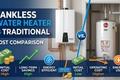
R-454B vs R-410A: What the Refrigerant Phase-Out Means for Homeowners
IRA Rebates & California Incentives 2026
The Inflation Reduction Act offers meaningful financial support for homeowners who install a new AC near them in California — but the program landscape shifted significantly in early 2026.
| Program | Amount | Eligibility | Status (Mar 2026) |
|---|---|---|---|
| IRA Section 25C — Central AC | Up to $600 | SEER2 ≥17.0, ENERGY STAR certified | Active |
| IRA Section 25C — Heat Pump | Up to $2,000 | ENERGY STAR Most Efficient. SEER2 ≥15.2 | Active — Best Value |
| TECH Clean CA (HEEHRA) | $1,000–$8,000 | Income-qualified (≤80% AMI) | Waitlisted (Feb 2026) |
| SCE / SoCal Gas Rebates | $100–$500 | Qualifying high-efficiency units | Active (check zip) |
| ENERGY STAR Smart Thermostat | Up to $100 | With qualifying AC upgrade | Active |
As of February 24, 2026, California's HEEHRA Phase I program has fully reserved its statewide budget. The IRA Section 25C federal tax credit (up to $2,000 for heat pumps) remains fully active for 2026. Source: California Energy Commission.
Stacking Your Rebates
A California homeowner installing a qualifying 17 SEER2 heat pump in Simi Valley in March 2026 could realistically access:
Total potential savings: $2,100–$2,600 on a qualifying heat pump installation.
Prices rise 12–22% after mid-May. NATE-certified installers in Simi Valley, Thousand Oaks & Moorpark — same-day available
Repair vs. Replace: The $5,000 Rule
Multiply your AC's age (years) by the cost of the repair ($). If the result exceeds $5,000, replacement is almost always the better financial decision. Example: 10-year-old unit + $600 repair = $6,000 → Replace.
✓ Lean Toward Repair When...
- Unit is under 8 years old
- Repair cost under $400
- System still under manufacturer warranty
- SEER2 rating is already 15+ (efficient)
- No refrigerant leaks detected
- First repair in 3+ years
✗ Lean Toward Replace When...
- Unit is 10+ years old
- Uses R-22 or R-410A (phase-out costs rising)
- Repair cost exceeds $1,200
- Second major repair within 18 months
- Monthly energy bills rising 20%+
- SEER rating below 14 (pre-2006 system)
"We waited until July last year and paid $400 more plus waited 12 days. This year we booked in February through HVAC Services Team and had the new Carrier system installed in 2 days. The new R-454B unit is noticeably quieter."
"The cost calculator on this page gave me a realistic range before I called anyone. The actual quote was right in the middle of the range. Really helped me plan the budget."
SEER2 Comparison Table: Which Rating Should You Buy?
SEER2 replaced the legacy SEER standard in 2023. The new test uses higher duct static pressure to better simulate real California home conditions. Here's how to choose the right efficiency tier for your Simi Valley or Southern California home.
| SEER2 Rating | Equipment Cost | Annual Energy Savings | IRA Tax Credit | Payback Period | Best For |
|---|---|---|---|---|---|
| 14.3 SEER2 | $3,200–$4,500 | Baseline | Not eligible | — | Budget-constrained installs |
| 15–16 SEER2 | $3,800–$5,500 | 5–10% savings | Not eligible | 8–12 years | Mild-climate or rentals |
| 17 SEER2 ⭐ | $4,500–$6,500 | 15–20% savings | $600 / $2,000 HP | 5–7 years | Best value — Simi Valley |
| 18–20 SEER2 | $5,500–$8,000 | 20–28% savings | $600–$2,000 | 6–9 years | Larger homes |
| 21+ SEER2 | $7,000–$12,000 | 28–35% savings | Up to $2,000 | 8–12 years | High-end / ZNE homes |
Equipment costs only. Add $2,000–$4,500 for installation labor, permits, and old unit disposal. See ENERGY STAR's tax credit eligibility tool →
For a Simi Valley home running AC 65–80 days per year at peak, the 17 SEER2 tier is the sweet spot. You'll qualify for the IRA $600 tax credit, recoup the efficiency premium within 5–7 years, and the R-454B refrigerant system is future-proofed through the 2030s.
SEER2 Explained: What Rating Makes Sense for Your California Home?
How to Size Your New AC for California Homes
Incorrect AC sizing is the #1 installation mistake in California homes. An oversized unit short-cycles (runs in short bursts, fails to dehumidify), while an undersized unit runs continuously and drives up energy bills. Both scenarios cut system lifespan by 30–40%.
Quick Sizing Reference (Simi Valley / Ventura County)
| Home Size | Recommended Tonnage | BTU/hr | Notes for Simi Valley Homes |
|---|---|---|---|
| Under 900 sq ft | 1.5 tons | 18,000 BTU | Condo or small home — check ceiling height |
| 900–1,300 sq ft | 2 tons | 24,000 BTU | Common for 1960s–70s Simi Valley ranch homes |
| 1,300–1,800 sq ft | 2.5–3 tons | 30,000–36,000 BTU | Most common Simi Valley single-family home size |
| 1,800–2,400 sq ft | 3–3.5 tons | 36,000–42,000 BTU | Add 0.5 ton for west-facing or poor insulation |
| 2,400–3,200 sq ft | 4–5 tons | 48,000–60,000 BTU | Zoning strongly recommended for two-story homes |
| Over 3,200 sq ft | 5+ tons or multi-zone | 60,000+ BTU | Manual J calculation required — call for site visit |
A licensed HVAC contractor should always perform a Manual J load calculation specific to your home's insulation, window orientation, ceiling height, and sun exposure before selecting a unit. Request a sizing assessment for your Simi Valley home →
How to Find a Vetted AC Installer Near You in California
When searching to install a new AC near me in California, homeowners face a critical vetting challenge: California has thousands of HVAC contractors, but quality varies enormously. Here's the checklist every homeowner should use.
| Credential / Check | What to Look For | Why It Matters |
|---|---|---|
| CSLB License | Active C-20 or C-10 license on cslb.ca.gov | Required by California law for residential HVAC work |
| NATE Certification | North American Technician Excellence badge | Industry gold standard for installation quality |
| EPA Section 608 | Required for all A2L (R-454B) refrigerant handling | New in 2026 — ensures safe R-454B handling |
| Written Quote | Itemized: equipment cost, labor, permits, removal | Protects against hidden charges |
| Permit Pulled | Contractor pulls city/county mechanical permit | Required in Simi Valley (93063, 93065) for new installs |
| Manual J Sizing | Written load calculation — not verbal estimate | Ensures correct unit size for your home |
- Confirm CSLB license on cslb.ca.gov
- Request written itemized quote
- Ask about Manual J sizing calculation
- Confirm A2L (R-454B) certified technician
- Verify permit will be pulled
- Ask about IRA rebate eligibility
- Get 2–3 competing quotes
- Check NATE certification
Don't Wait Until Summer — Install Before Prices Spike
June–August quotes in Simi Valley run $1,200–$2,400 higher than the same job booked today. Lock in your spring rate now — free estimate, no obligation, same-day available across Simi Valley, Chatsworth and Woodland Hills.
Frequently Asked Questions
Seasonal questions homeowners in Simi Valley and Southern California are searching most in March, April, and May 2026.
Still Have Questions? Book Your Free Expert Consultation.
Every week you wait costs more. Spring slots are closing — get matched with a NATE-certified, CSLB-licensed Simi Valley installer today. Free estimate, no pressure, same-day available.
About the Author

Mubashar Shahzad is a certified digital marketing strategist and SEO researcher with 4 years of experience in the home services and HVAC industry. His research on local search optimization and consumer behavior in the home improvement sector has been published across multiple industry platforms. Mubashar's work focuses on helping homeowners make informed decisions about heating, cooling, and energy efficiency.